AI & Empowering People
Digital Training
Article published in Issue 10/26
AI Compass for Executives (WEKA Business Media AG)
From Cyber Risk to Behavior: How AI Is the Final
A Mile of Cybersecurity Bridged
Regulation, governance, and risk management make cyber risks visible and manageable. However, simply documenting a risk does not automatically lead to the right response at the critical moment.
Generative AI trained for educational purposes can bridge this last mile: It translates
Risks specific to the company and role-based
Work situations make cybersecurity awareness more relevant.
By Roger Hubmann

Regulated—but far from protected
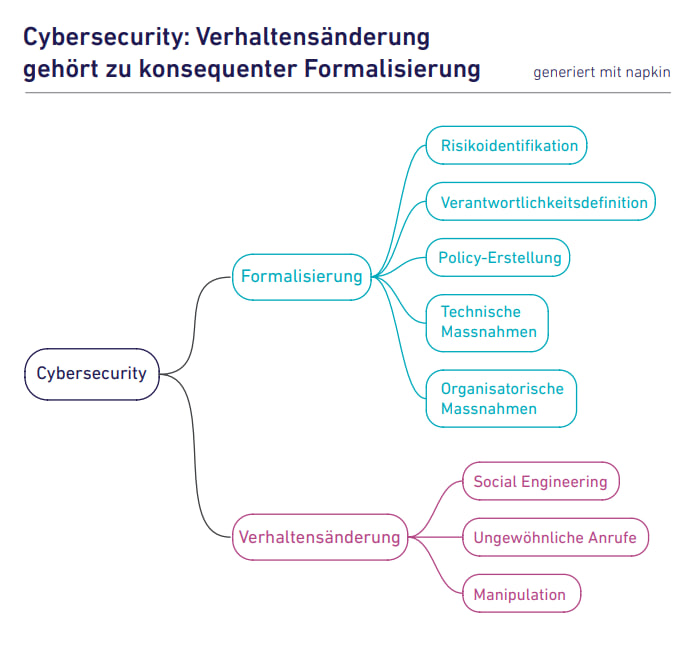
Cybersecurity is becoming increasingly formalized: Companies identify risks, define responsibilities, establish policies, and implement technical and organizational measures. An Information Security Management System (ISMS) provides a structured framework for this
But there is a gap between a risk documented in the ISMS and actual behavior in day-to-day work. Social engineering, for example, may be identified as a corporate risk and addressed through reporting channels, controls, and rules. Nevertheless, an employee must recognize that an unusual phone call is not simply an urgent customer inquiry—or a finance employee must realize that a message purportedly from senior management could be a scam. A documented risk, therefore, does not automatically translate into the right behavior at the critical moment. This is precisely where the “last mile” of cybersecurity begins.
Managing risks does not necessarily mean controlling behavior
Risk management operates at the organizational and process levels. People encounter cyber risks in specific situations. The same risk therefore manifests differently depending on a person’s job role. For a customer service representative, social engineering might take the form of a manipulative phone call; in finance, a deceptively genuine payment request; in HR, a request for confidential personnel data; and on a construction site, an unknown supplier. The response and decision-making context vary accordingly.
Anyone who wants to influence behavior must therefore translate it: from corporate risk through processes and job roles to the specific situation and the expected behavior. Only then does an abstract cyber risk become recognizable in one’s own work environment.
Same Training, Different Risks
Cybersecurity awareness is intended to support this translation. In practice, however, very different roles are often trained using the same content. Interactivity is frequently lacking; participants dutifully click through the training modules, but little of it is truly internalized. While phishing, social engineering, and data protection are relevant to many, the actual risk scenarios vary considerably.
The further a training program is removed from the real-world risk situations of a job role, the less it helps develop the necessary reflexes. Role- and company-specific content would be the obvious choice, but until now it has been time-consuming: analyzing risks, taking roles into account, developing scenarios, producing content, conducting technical reviews, updating the material, and, if necessary, making it available in multiple languages. What would make sense from a risk management perspective was therefore only scalable to a limited extent. But what if cybersecurity training no longer had to compete for attention—because it reflected employees’ own risks, tasks, and work situations?
AI Makes Relevance Scalable
Much of the necessary information is already available. Risk analyses and audits identify vulnerabilities, policies define rules, processes outline procedures, and job descriptions outline tasks and responsibilities. Cybersecurity experts contribute their technical and industry knowledge as well as insights into current threat scenarios.
Generative AI can consolidate this information and translate it into learning contexts. It helps map risks to roles and processes, develops plausible work situations, and uses them to generate scenarios, dialogs, exercises, or knowledge checks. A single social engineering risk can thus give rise to a variety of learning environments for customer service, logistics, HR, or management.
What’s new is not so much cybersecurity knowledge as the ability to scale its application to relevant work situations. AI does not replace subject-matter expertise. It makes it more cost-effective to apply that expertise to different roles—provided that sources, results, and expected behavior are subject to professional oversight.
Going the Last Mile: Five Steps from Risk to Behavior
Such an approach can be organized as a controllable process:
Identifying Risks from a Technical Perspective: The starting point consists of risk analyses, audits, incidents, and the assessments of cybersecurity managers. Evaluation and prioritization remain the responsibility of the relevant experts.
Identify affected roles and processes: Risk, process, and role information is consolidated to identify where a risk becomes relevant in day-to-day work.
Using AI to develop specific risk scenarios: Abstract risks are transformed into plausible scenarios, such as an unusual phone call or a decision made under time pressure.
Creating AI-powered, relevant learning environments: This results in role-specific scenarios, games, exercises, and knowledge checks, available in different languages as needed.
Validate awareness training programs from a technical perspective and assess their effectiveness: Cybersecurity managers review the scenario, recommended actions, and expected behavior.
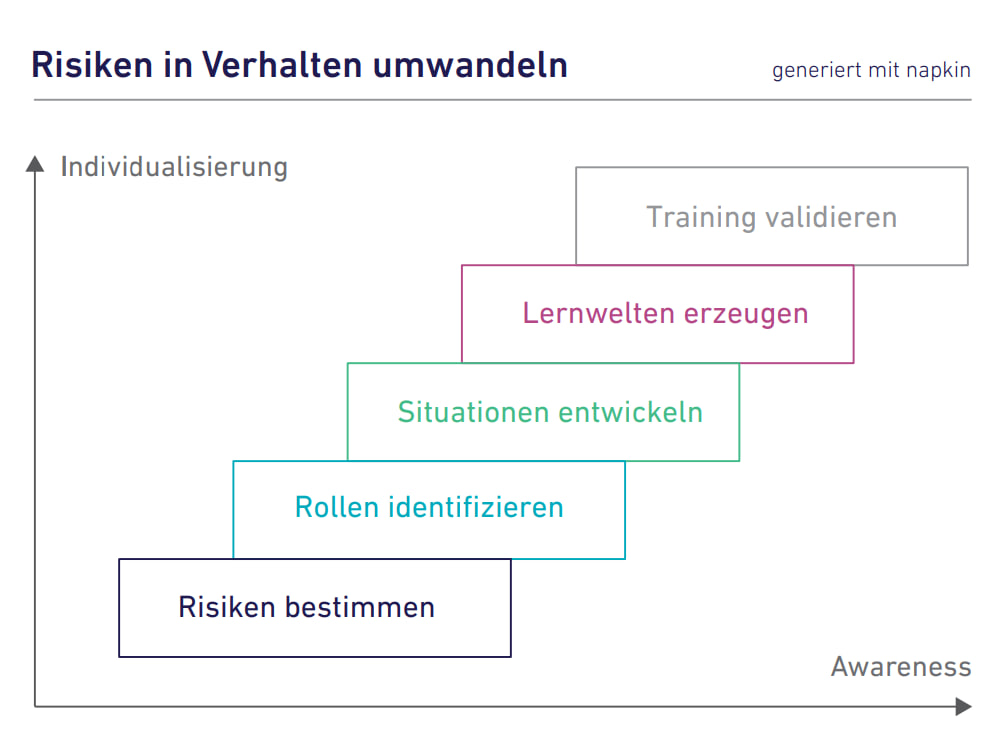
This means that cybersecurity training no longer begins with the existing course, but with the identified risk.
The Second Governance Task
Anyone who uses AI to translate cyber risks into relevant work scenarios and training exercises creates a second governance task. This is because the more company-specific the learning content is, the more internal context the AI requires. Risk analyses, audit results, processes, role profiles, or documented incidents can be valuable but sensitive sources of information.
Four questions are key: What data may be used for AI-supported training development? Which approved systems are permitted to process this data? On what professionally authorized knowledge base does the AI generate scenarios and recommendations for action? And who reviews and approves the results?
Governance is not the antithesis of AI-driven personalization, but rather its prerequisite. Data access, sources, and responsibilities must be clearly defined.
The last mile becomes a leadership challenge
Regulation, governance, and risk management lay the groundwork for cybersecurity. Whether this leads to greater security also depends on how employees handle risks in their day-to-day work.
Generative AI makes it possible to address this “last mile” on a large scale: risks can be translated into roles, processes, and specific work situations, and relevant learning environments can be developed from them. Scaling through AI replaces neither cybersecurity expertise nor human responsibility. This also changes the role of leadership. It is not enough to meet regulatory requirements and provide awareness training. What is crucial is the clear connection between identified risks and expected behavior—and adapting this connection to new risks.
Regulation sets the framework. Safety is achieved when that framework translates into the right behavior at the right moment.
Article published in Issue 10/26
AI Compass for Executives
(WEKA Business Media AG)