Article in the eLearning Journal, March 2026.
Author: Roger Hubmann
Measurable ROI in Talent Development Through Managed AI
Shorter attention spans, cost pressures, and unabated demand—amid these challenges in L&D, a new savior is emerging: artificial intelligence. But its pitfalls are fueling skepticism.
Experience and statistics clearly show that companies that rely on guided production processes managed by agents trained in instructional methods will find AI to be a game-changer in terms of effectiveness and cost efficiency. This is how AI drives efficiency gains in business processes.
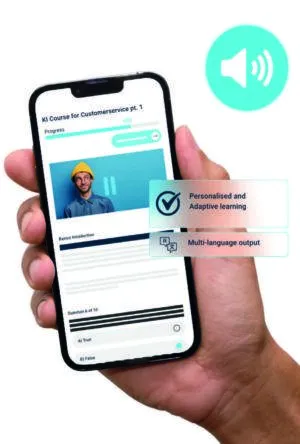
Changing media consumption habits call for new approaches to employee training
Studies on media consumption show crystal clear: Attention spans—especially among younger generations—are steadily declining due to modern social media algorithms and their ultra-short videos. This also impairs the ability to learn. Added to this is the distraction caused by smartphones, which prevents many people from achieving deep concentration.
Due to an ever-increasing workload, the time available for professional development in companies is decreasing—course time in Germany has fallen from over 17.4 hours per year to just 13.7 hours per year. This means that more knowledge must be imparted in less and less time, while L&D budgets are often shrinking.
For the HR team tasked with optimizing a company’s skills matrix under these circumstances, this situation is, of course, extremely challenging. This is often compounded by the fact that e-learning tools (such as SCORM) are outdated in many companies, and that there is a lack of in-house expertise in content creation—even though great importance is placed on retaining know-how within the company. Added to this is a general and growing shortage of skilled workers.
Artificial intelligence is now expected to solve all these problems at once—a fact that has long been common knowledge since the widespread hype surrounding generative AI. And one thing is clear: AI’s potential for human resources development is indeed enormous. This is evident from the fact that, according to surveys in the U.S., 39.4% of all L&D professionals are already using AI strategically.
Specifically, two outstanding innovations have sparked this trend toward AI: First, the ability to use artificial intelligence to create educational content from internal knowledge in a matter of minutes. In terms of costs, this is an absolute game-changer. Second, AI also enables the efficient, skill-driven personalization of learning content, which leads to significantly improved learning outcomes. Directly and practically incorporating users’ prior knowledge and skill gaps is finally becoming a reality.
The L&D Revolution Through Managed AI
Just as the media industry has been turned upside down in recent years by user-generated content and smartphones, AI-based professional development is now revolutionizing talent development—with AI-generated learning content curated by in-house experts.
At least 80% of all content is generated by AI, based on state-of-the-art teaching methods and informed by the company's expertise. This content is available in dozens of languages without the need to budget for translations.
What's particularly exciting is that content creation remains entirely in-house. The final touches are made using a user-friendly LMS. The result is more effective content over which you always have 100% control.
A Technological Breakthrough in Human Resources Development
This is made possible by advanced managed AI systems. These systems initially create complete instructional content and course programs entirely autonomously. Within a few minutes, all currently relevant content is generated based on the most up-to-date information from previously defined sources. The Managed AI Cypher Agent, which orchestrates the work of specialized AIs, regulates itself autonomously and outsources the generation to expert agents depending on the task. At the same time, it enables the content to be delivered to users in the most suitable formats and media: video, audio, VR, and infographics.
By bringing learning content to where our attention is most focused, we can further improve results. After all, learning is most effective when it’s fun. AI helps us achieve exactly that by seamlessly converting content into any medium or format—whether on a smartphone, a tablet, right in our work environment, or through voice conversation.
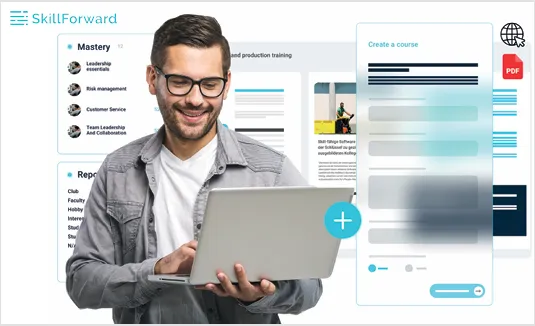
AI agents trained in instructional design enable L&D professionals and team and compliance managers to create training courses themselves and keep them up to date with ease.
AI-Powered Personalization of Educational Content—The Game-Changer for Learning Success
Personalization dramatically improves the efficiency and success of continuing education. A meta-analysis by the University of Freiburg showed that personalized learning resulted in an average 16 % increase in learning performance compared to traditional, standardized instruction. IU Erfurt was able to demonstrate that, compared to standardized content, personalized learning led to a 12 % increase in engagement, a 9 % increase in satisfaction, and a 7 % reduction in the time required to complete a program.
Personalization using AI is like talent development on steroids. CYPHER Agent Managed AI isn’t just capable of creating content quickly, effectively, and efficiently—it can also recommend content based on each employee’s skill set. As a result, entire course programs can already be tailored and developed automatically today.
And the rapid development of such systems will bring further benefits: Soon, it will even be possible to tailor course content to the learning habits of individual employees, so that it precisely matches their cognitive abilities.
Enthusiasm for Content as the Key to Learning Success
One of my principles for successful learning is engagement: Content has to be fun—and that varies from person to person. While creating company-specific content—or content personalized for individual employees—manually is simply not feasible, modern systems like Cypher Learning can generate such content at the click of a button. In practice, this means that content is created based on a skill gap analysis, which can draw on information from the internet, uploaded documents, and internal sources. The system is thus able to provide tailored learning recommendations by identifying knowledge gaps and adapting the course curriculum for users accordingly.
AI Is the Future of L&D
Our day-to-day work at Skill Forward clearly shows that this approach makes it possible to overcome most of the challenges associated with knowledge transfer and employee development in companies—and to do so more cost-effectively and faster than ever before. This is evident not least in the ROI of such systems, which our methods make directly measurable: Employees become productive faster thanks to targeted onboarding, and compliance risks are minimized through user-friendly and practical training. Training costs are also significantly reduced through the shift to online platforms and AI-generated content.
For us at Skill Forward, one thing is certain: The future of talent development lies in Managed AI. It’s worth gaining experience and taking advantage of this effective, innovative approach. You can now try out the Cypher Learning System risk-free as part of the AI Creator Community. L&D departments can develop their AI roadmap through mini-workshops, identify early efficiency gains, and are guaranteed to always be up to date when it comes to L&D.
Read the article in the eLearning Journal.